
Wood Flooring Glossary
Wood flooring has a vocabulary that decides quotes. This glossary defines the 28 terms that come up most often in refinishing and installation work, in the sense the trade actually uses them.
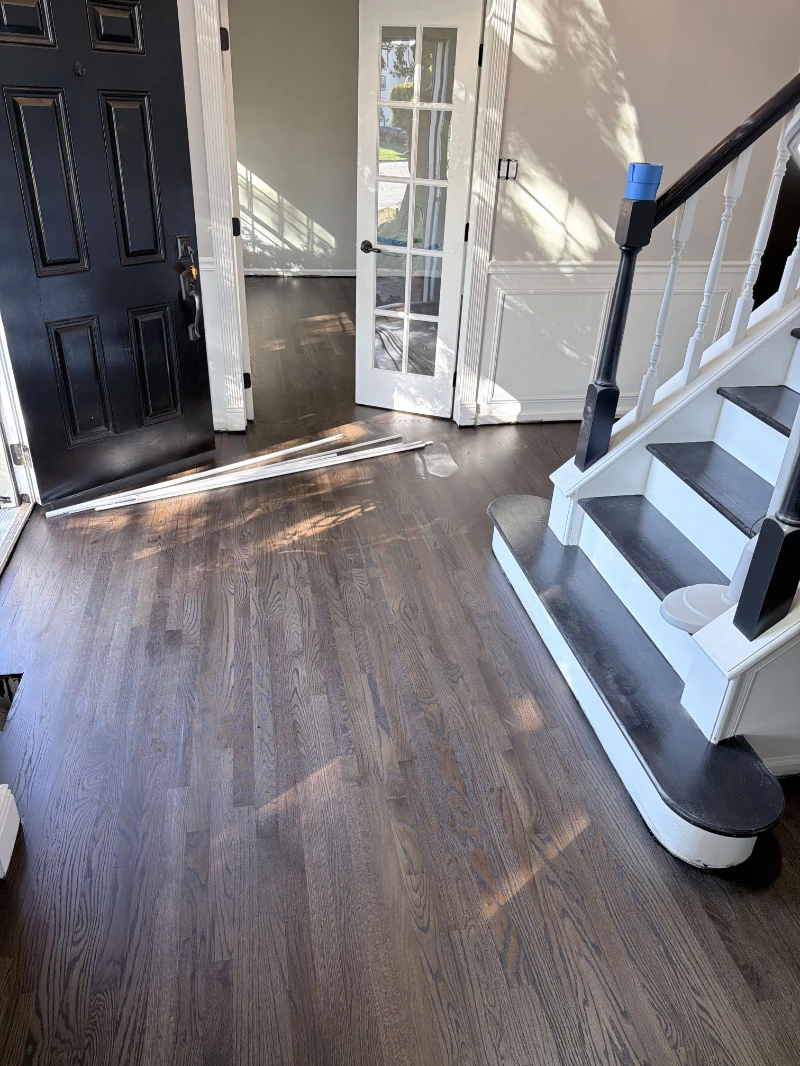
Refinishing
Sanding a wood floor back to bare wood, then applying stain (optional) and a new finish. Refinishing removes material from the board, so it can only be repeated while enough wear layer remains above the tongue.
Screen and Recoat
Also called: Buff and Coat, Recoat
Lightly abrading only the existing finish layer, without cutting into the wood, then applying a fresh coat. It restores sheen and protection without consuming wear layer, but it cannot remove stains, gray areas or deep scratches.
Grit Sequence
The progression of abrasive grits used when sanding a floor, for example 36 to 60 to 80 to 100. Skipping a grit leaves scratch marks from the previous one that only become visible once finish is applied.
Moisture Content (MC)
The amount of water in wood expressed as a percentage of its oven-dry weight. NWFA guidelines call for no more than 4 percent difference in moisture content between the subfloor and solid strip flooring before installation.
Relative Humidity (RH)
The amount of water vapor in the air relative to what the air can hold at that temperature. The industry reference range for installing and acclimating wood flooring is 30 to 50 percent RH at 60 to 80 degrees Fahrenheit, held steady for at least five days before material is delivered.
Acclimation
The period during which wood flooring sits in the space where it will be installed until its moisture content reaches equilibrium with local conditions. Installing without acclimating is one of the most common causes of cupping and gapping.
ASTM F2170
The standard test method for measuring relative humidity inside a concrete slab using in-situ probes. It is the reference test before installing flooring over concrete.
ASTM F1869
The standard test method for measuring the moisture vapor emission rate of a concrete subfloor using anhydrous calcium chloride.
Vapor Retarder
A layer that limits water vapor moving from the subfloor into the wood floor above. NWFA recommends an impermeable retarder with a perm rating of 0.15 or lower.
Cupping
A distortion where board edges sit higher than the center, caused by more moisture on the underside than the top. It signals a moisture problem that must be found and corrected before any sanding.
Crowning
The opposite of cupping: the center of the board sits higher than the edges. It often results from sanding a floor flat while it is still cupped, before the moisture has equalized.
Wear Layer
The usable thickness of wood above the tongue on a solid floor, or the top hardwood veneer on an engineered floor. It determines how many times a floor can still be sanded.
Site-Finished Flooring
Flooring sanded and finished in place after installation. It produces a continuous surface with no beveled seams between boards and allows custom stain color, unlike factory prefinished flooring.
Waterborne Polyurethane
A water-based floor finish that dries quickly, has low odor and low VOC content, and keeps the natural color of the wood without ambering over time.
Oil-Modified Polyurethane
A solvent-based floor finish that cures more slowly and has strong odor, giving wood a warm amber tone that continues to yellow over the years.
Hardwax Oil
A penetrating oil and wax finish that saturates the wood fiber instead of forming a surface film. It allows spot repair of a damaged area without recoating the entire floor.
Dustless Sanding
Sanding with equipment connected to a vacuum and containment system, usually with HEPA filtration. It sharply reduces airborne dust, though no system removes dust entirely.
EPA RRP (Lead-Safe Renovation, Repair and Painting)
A US federal rule requiring certified firms and contained work practices whenever a job disturbs painted surfaces in housing built before 1978, because of lead paint risk.
New Jersey Home Improvement Contractor (HIC)
Mandatory registration with the New Jersey Division of Consumer Affairs for anyone performing residential home improvement work in the state, including floor covering. It issues a number beginning with the prefix 13VH that must appear on contracts, estimates, advertisements, business cards and commercial vehicles, and it has to be renewed every year by 31 March.
NWFA (National Wood Flooring Association)
The US trade association that publishes the Wood Flooring Installation Guidelines, the technical reference for installation, acclimation and moisture testing of wood floors.
Red Oak
The dominant species in residential wood flooring across the US Northeast, commonly found as 2 1/4 inch strip in postwar houses. Open-pored, it takes stain evenly.
White Oak
Harder and less porous than red oak, with a more neutral undertone. Preferred for light finishes and reactive stains.
Heart Pine
A softwood common as original flooring in houses built before 1940. Softer than oak, it calls for a lighter sanding pass and closer attention to the remaining wear layer.
Parquet
Flooring made of short pieces laid in a geometric pattern such as herringbone or block. It requires sanding in multiple directions because there is no single grain direction.
Janka Hardness
A test that measures a wood species' resistance to indentation. It is used to compare species for dent and wear resistance.
Engineered Wood Flooring
Flooring with a hardwood veneer over a multi-ply substrate. It is more dimensionally stable against moisture than solid wood, but the number of times it can be sanded is limited by veneer thickness.
Luxury Vinyl Plank (LVP)
A multilayer vinyl plank that imitates wood. It is waterproof and dimensionally stable, which suits basements and wet areas, but it cannot be sanded or refinished.
Laminate Flooring
Flooring with a printed decorative layer over a high-density fiberboard core. It resists scratching but is sensitive to moisture and cannot be refinished.
Still not sure what you are being quoted?
Send us the estimate you received. We will tell you what it does and does not cover.
Request a free estimate