
Parquet & Herringbone Restoration in Cranford, NJ
Parquet & Herringbone Restoration for homes in Cranford, Union County.
- 1951 median year built
- 85.4% built before 1978
- 9,619 housing units
- Union County
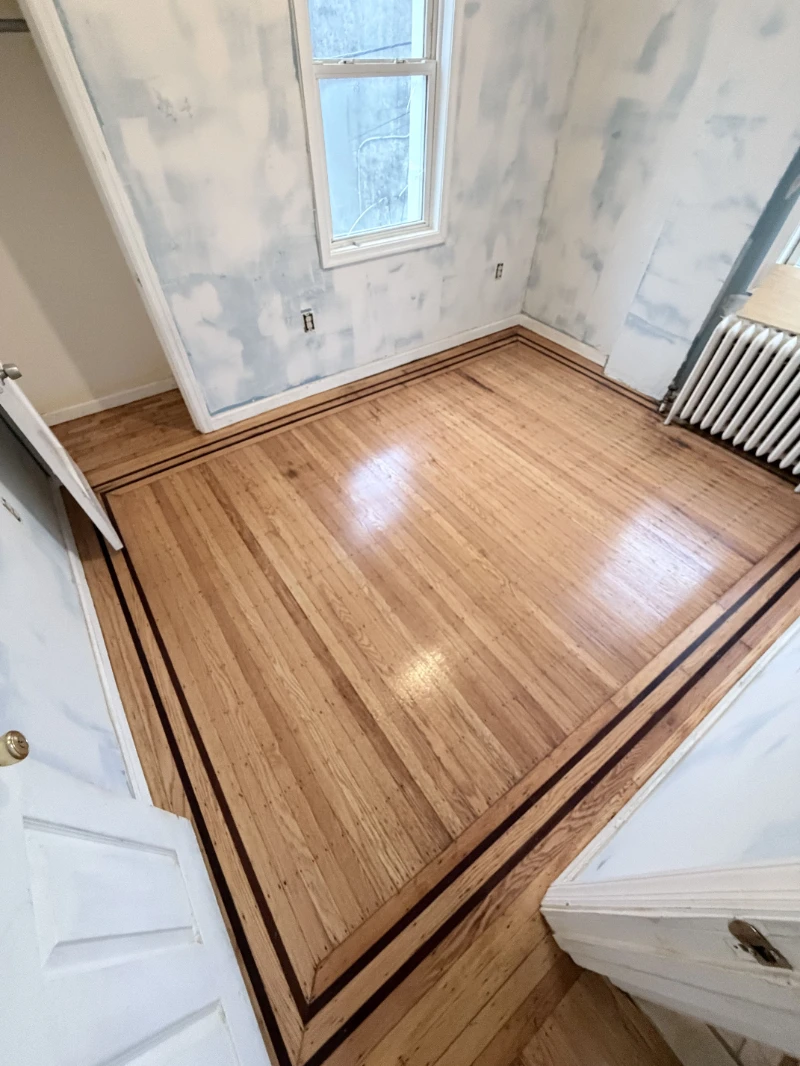
The median Cranford home dates to 1951, and about 85.4% of the housing stock predates 1978 — which shapes what is under the finish and how the work has to be done.
What Cranford floors are usually made of
With a median build year of 1951 and 30.8% of homes predating 1940, Cranford has a genuinely mixed housing stock — which means the floor has to be identified before the work is scoped.
A mixed-era town is the hardest one to generalise about. Two houses on the same street in Cranford can have completely different floors under the finish: original narrow board in one, postwar red oak strip in the other.
We do not assume. Wear layer, board width and species get checked on site, because the answer changes the method and the price.
How Cranford compares
Housing here runs about 4 years older than the Union County median of 1955.
At 85.4% pre-1978, Cranford sits in the oldest quarter of the 185 towns we serve. Neighbouring Clark is a different picture — median 1962 against 1951 here — which is why we quote by address rather than by area. Cranford is about 28 miles from our base in Eatontown.
Housing data for Cranford
These are the Census figures behind everything above — published so you can check them rather than take our word for it.
| Median year built | 1951 |
|---|---|
| Built before 1978 (approx.) | 85.4% |
| Built before 1940 | 30.8% |
| Housing units | 9,619 |
| Population | 23,841 |
| County | Union County |
Source: US Census Bureau, ACS 2023 5-Year Estimates. The pre-1978 share is an approximation — see how it is derived.
Lead-safe requirements in Cranford
About 85.4% of Cranford homes were built before 1978, so work that disturbs painted baseboards, shoe molding or stair components will usually fall under the EPA's lead-safe rule.
This is the normal condition of a Cranford job, not an exception to plan around. The exposure is at the edges of the floor — sanding equipment runs directly against painted trim.
Dust containment and lead-safe practice are different things. A containment system manages nuisance dust; the RRP rule addresses a regulated hazard and carries its own containment, cleaning and verification requirements. Ask about both, separately.
The pre-1978 figure is approximate — see the method note on our housing data page for how it is derived.
Parquet & Herringbone Restoration, in short
Parquet and herringbone floors are laid in geometric patterns, which means there is no single grain direction to sand with. They require a different approach from strip flooring, and they are common in exactly the older New Jersey housing where the floors are most worth saving.
The full technical detail — method, materials and what decides the outcome — is on our parquet & herringbone restoration page.
How to check a flooring contractor in Cranford
Ask for the New Jersey home improvement contractor registration number, which begins with the prefix 13VH, and verify it free on the state's public lookup before you sign anything. The status has to read Active: registration expires every 31 March.
New Jersey has no flooring-specific trade licence. HIC registration is the requirement, and state rules put that number on contracts, estimates and advertisements, which makes it checkable before money changes hands.
Beyond registration, the things that actually distinguish crews are checkable too: moisture readings taken before the quote rather than after, a stated grit sequence, and named finish products you can look up a data sheet for.
- 13VH registration number, verified current on the state lookup
- Moisture readings taken and put in writing before quoting
- A stated grit sequence, not just "we sand it"
- Named finish products with published technical data sheets
- EPA Lead-Safe certification if the house predates 1978
- Proof of insurance, with coverage amounts stated
Parquet & Herringbone Restoration in towns near Cranford
We work Cranford and the surrounding Union County area. These are the nearest towns we also cover.
Frequently asked questions
Do you serve Cranford, NJ?
Yes. Cranford is one of the 185 New Jersey municipalities we cover, across nine counties.
How old are most homes in Cranford?
The median Cranford home was built in 1951, and about 85.4% of the housing stock predates 1978. Figures are from the US Census ACS 2023 5-year estimates.
Does the EPA lead-safe rule apply to my Cranford home?
With roughly 85.4% of Cranford housing built before 1978, it applies to most addresses here. Your municipal tax record lists your year built, which is what decides it.
Do I need a permit for parquet & herringbone restoration in Cranford?
Floor refinishing and like-for-like replacement generally do not require a permit in New Jersey. Structural work, subfloor replacement or changes to the building do. Confirm with the Cranford construction office for your specific scope.
How far in advance should I book?
It varies with season — heating season and the weeks before holidays are the busiest. Contact us with your timeframe and we will tell you honestly what is available.
What does parquet & herringbone restoration cost in Cranford?
We do not publish a per-square-foot figure, because the honest number depends on the floor: square footage is only the starting point, and edge work, stairs, closets, coat count, stain and lead-safe requirements all move it. We quote in writing after seeing the floor and taking moisture readings.
Get your Cranford floor quoted properly
We take moisture readings and check wear layer before putting a number on the job, so the quote reflects what your floor can actually support — not a rate per square foot applied blind.
Request a free estimate