
The 4% Moisture Rule
The difference in moisture content between a subfloor and the solid strip flooring installed over it should not exceed 4%.
- 5.0★★★★★85 Google reviews
- Since 2008
- 185 New Jersey towns
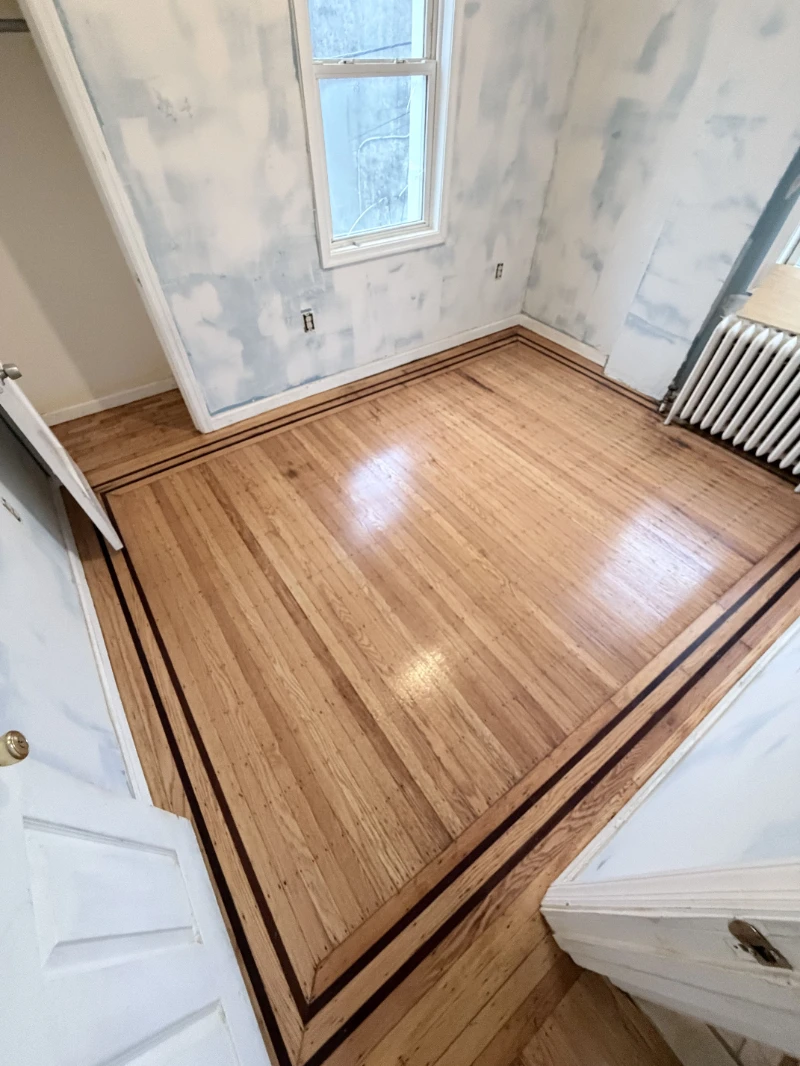
It is the single most useful number in wood flooring, because nearly every failure that appears in the first two years is a moisture difference that was never measured.
Key facts
| Maximum difference | 4% between subfloor and solid strip flooring |
|---|---|
| Jobsite temperature | 60–80 °F |
| Jobsite relative humidity | 30–50% |
| Conditions held before delivery | At least 5 days |
| Readings required | Minimum 20 per 1,000 sq ft, averaged |
What moisture content actually measures
Moisture content is the amount of water in wood expressed as a percentage of its oven-dry weight, and wood changes dimension as that percentage moves.
Wood is hygroscopic: it takes on and gives up water until it reaches equilibrium with the air around it. That equilibrium point shifts with the seasons, which is why solid wood floors in the Northeast are slightly tighter in August and show fine gaps in February.
Seasonal movement is normal and expected. What is not normal is movement caused by installing two materials that were never near equilibrium with each other.
Why 4% and not zero
A perfect match is neither achievable nor necessary; 4% is the tolerance within which the resulting movement stays inside what the floor assembly can absorb.
Beyond that spread, the equalization that follows installation produces enough dimensional change to show as cupping, gapping or fastener movement. Wider boards tighten the tolerance further, because a given percentage of movement covers more inches across a wider plank.
Why this matters more in older New Jersey housing
Older houses combine below-grade subfloors, seasonal humidity swings and heating systems that dry interiors aggressively in winter — the conditions in which moisture differences are largest.
A large share of New Jersey's housing stock predates 1978, and a meaningful part predates 1940. Those houses were built before continuous vapor control was standard practice, and many have subfloors over unconditioned crawlspaces or basements.
The practical consequence is that the moisture reading matters more here than in newer construction, not less — and a contractor who does not take one before quoting is quoting on an assumption.
What a homeowner should ask for
Ask for the readings in writing: the meter used, where readings were taken, the subfloor value, the flooring value, and the room conditions on the day of the test.
This is not an unusual request and it costs the contractor nothing if the work was done. A contractor who cannot produce readings did not take them.
Frequently asked questions
What is an acceptable moisture content for hardwood flooring?
The acceptable value depends on your region and season. What matters more is the relationship: the difference between the subfloor and the flooring should not exceed 4% for solid strip flooring.
Why did my new floor cup after installation?
Cupping means the underside of the boards is wetter than the top. It usually indicates moisture coming from below — a damp crawlspace, an unsealed slab, or flooring installed before the subfloor moisture was in range.
Should I sand a floor that is cupped?
Not until the moisture source is found and the floor has equalized. Sanding a cupped floor flat produces crowning once the boards flatten out, which is a worse problem than the one you started with.
Do gaps between boards in winter mean the floor was installed wrong?
Not necessarily. Fine seasonal gaps in a solid wood floor during heating season are normal. Gaps wide enough to catch a coin, or gaps that do not close in summer, are not.
How is moisture in a concrete slab measured?
By in-situ relative humidity probes under ASTM F2170, or by anhydrous calcium chloride under ASTM F1869. The RH probe method reads conditions inside the slab rather than only at the surface.
Sources & references
- NWFA Wood Flooring Installation Guidelines — https://nwfa.org/wp-content/uploads/2026/02/NWFA-Installation-Guidelines.pdf
- ASTM F2170 — Standard Test Method for Determining Relative Humidity in Concrete Floor Slabs Using in situ Probes — https://www.astm.org/f2170-19a.html
- ASTM F1869 — Standard Test Method for Measuring Moisture Vapor Emission Rate of Concrete Subfloor Using Anhydrous Calcium Chloride — https://www.astm.org/f1869-23.html
Need this looked at on your floor?
Free written estimate, and moisture readings taken before we quote.
Request a free estimate