
Engineered Hardwood Installation
Engineered flooring puts a hardwood veneer over a multi-ply core, which makes it far more stable against moisture than solid wood.
- 5.0★★★★★85 Google reviews
- Since 2008
- 185 New Jersey towns
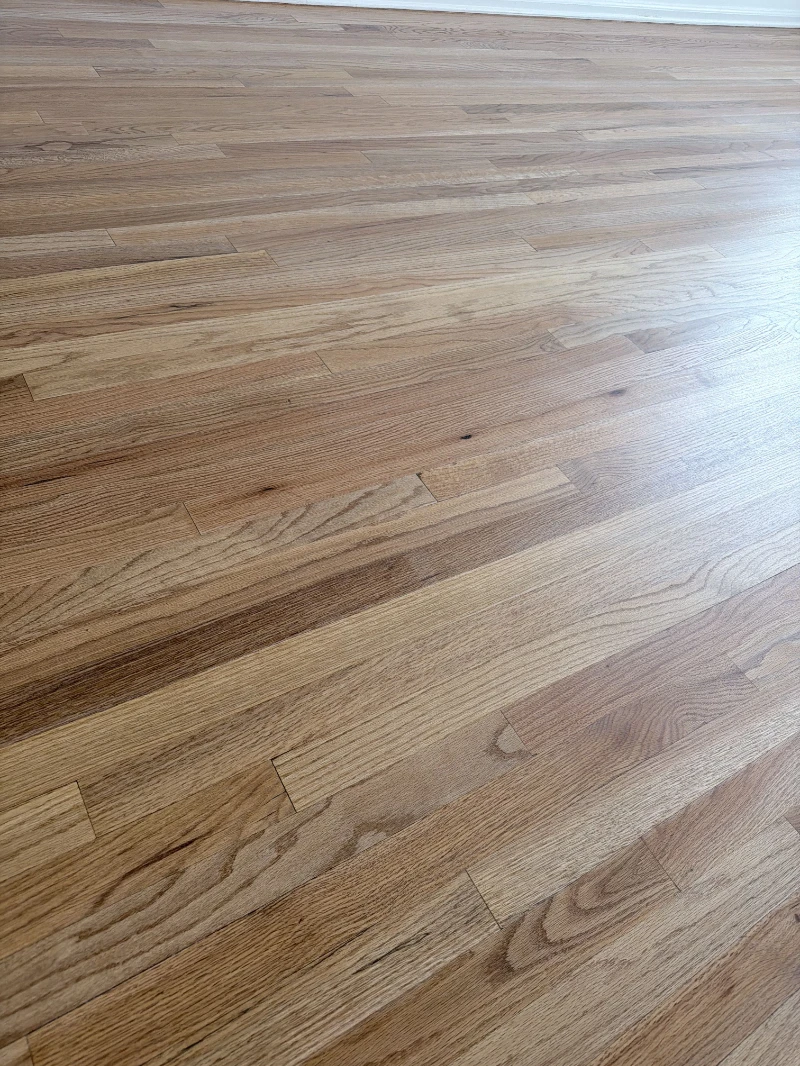
That stability is why it goes places solid cannot — over concrete, over radiant heat, below grade. The trade-off is the veneer: it sets how many times the floor can ever be sanded.
Key facts
| Construction | Hardwood veneer over multi-ply core |
|---|---|
| Advantage | Dimensional stability against moisture and humidity swings |
| Limitation | Sanding limited by veneer thickness |
| Installation methods | Glue-down, float, or nail, depending on product and subfloor |
| Over concrete | Requires slab moisture testing — ASTM F2170 or F1869 |
The veneer thickness is the specification that matters
A thicker wear veneer can be sanded and refinished; a thin one may only tolerate a light abrasion, or nothing at all.
Two engineered floors that look identical on the showroom floor can differ completely in service life, and the difference is not visible after installation.
Ask for the wear-layer thickness before buying. It is the single number that decides whether you own a floor you can restore in fifteen years or one you will replace.
Where engineered is the right call in New Jersey
Below-grade rooms, concrete slabs, radiant heat, and any space with wider humidity swings than the rest of the house.
Finished basements are the common case here. A slab carries vapor drive from the ground, and solid wood responds to that by moving. Engineered construction resists it.
This does not remove the need to test the slab. Stability is relative, not absolute, and manufacturers still specify moisture limits.
Installation method follows the product and the subfloor
Glue-down, floating and nail-down each suit different assemblies, and the manufacturer's instructions govern which are permitted.
A floating floor is fastest and tolerates minor subfloor variation, but it sounds different underfoot and needs perimeter expansion space throughout.
Glue-down feels more solid and is common over concrete, but it depends on a clean, flat, dry slab and on adhesive compatibility with the moisture readings.
How VGJ Floors installs engineered hardwood
Test the subfloor
Take moisture readings, and for concrete run in-situ RH or calcium chloride testing as the manufacturer specifies.
Confirm method and warranty terms
Match installation method to the product's instructions so the material warranty stays intact.
Prepare and flatten
Correct flatness variation, which matters more for floating installations than for nailed ones.
Acclimate as specified
Follow the manufacturer's acclimation instructions, which differ from solid wood.
Install with expansion space
Glue, float or nail per specification, maintaining perimeter expansion throughout.
Trim and transitions
Fit base, shoe and thresholds, detailing transitions to adjoining surfaces.
Frequently asked questions
Can engineered hardwood be refinished?
It depends entirely on the wear-veneer thickness. Thicker veneers can take a full sanding; thin ones may support only a light abrasion, or none at all.
Is engineered flooring real wood?
Yes. The visible surface is hardwood. What differs is the core beneath it, which is engineered for stability.
Can engineered go in a basement?
Often yes, subject to slab moisture testing and the manufacturer's limits. It is usually the better choice below grade than solid wood.
Does engineered flooring work over radiant heat?
Many engineered products are approved for radiant heat, but the approval is product-specific and comes with temperature limits that must be followed.
Floating or glue-down — which is better?
Neither universally. Glue-down feels more solid underfoot and is common over concrete; floating is faster and more tolerant of minor subfloor variation. The product's instructions and the subfloor decide.
Get this quoted properly
We take moisture readings and check wear layer before putting a number on the job — so the quote matches what your floor can support.
Request a free estimate