
Laminate Flooring Installation
Laminate puts a printed decorative layer over a high-density fiberboard core.
- 5.0★★★★★85 Google reviews
- Since 2008
- 185 New Jersey towns
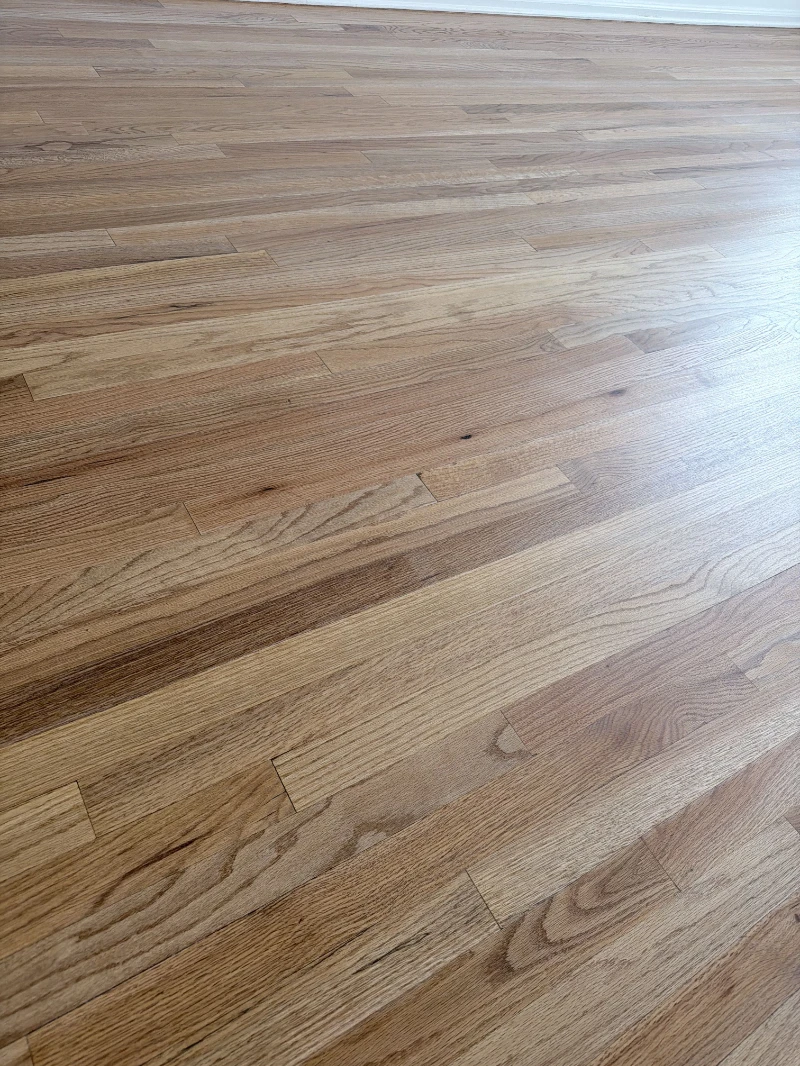
It resists scratching and surface wear well, which suits busy households and rentals. Its weakness is the core: HDF is a wood product, and standing water at a seam will swell it permanently.
Key facts
| Construction | Printed decorative layer over high-density fiberboard core |
|---|---|
| Strength | Scratch and surface wear resistance |
| Weakness | Core swells if water reaches it and does not recover |
| Refinishable | No |
| Installation | Floating, over underlayment, with perimeter expansion space |
Laminate versus LVP, honestly
Laminate generally wins on scratch resistance; LVP wins decisively on water. The choice follows the room.
For a busy hallway or a household with dogs, laminate's wear layer holds up well. For a basement, a laundry or a bathroom, LVP is the correct answer and laminate is a future repair.
Neither can be refinished, so both are replacement-cycle products rather than restorable ones.
Underlayment does real work
A floating floor over a hard substrate needs underlayment for sound, for comfort underfoot, and in some assemblies for moisture control.
It is where cost is cut invisibly. The finished floor looks identical on day one and sounds different underfoot for its whole life.
Expansion space is not negotiable on a floating floor
A floating floor is not fastened down, so it has to be free to move at every perimeter — walls, columns, door jambs and pipe penetrations.
A floating floor pinned at any point will peak or separate at the seams when it expands. This is the most common failure in laminate installations, and it is entirely preventable.
How VGJ Floors installs laminate flooring
Assess the substrate
Check flatness, soundness and moisture conditions against the manufacturer's requirements.
Flatten as needed
Correct variation that would cause seam movement or hollow spots in a floating assembly.
Acclimate the material
Bring planks to room conditions per the manufacturer's instructions.
Lay underlayment
Install the specified underlayment, including any moisture layer the assembly calls for.
Install floating with expansion space
Maintain perimeter gaps at every wall, column, jamb and penetration.
Trim and transitions
Fit base, shoe and transitions without pinning the floating floor.
Frequently asked questions
Is laminate waterproof?
No. The surface sheds water, but if water reaches the HDF core through a seam or an edge, the core swells and does not return to shape.
Laminate or LVP for a basement?
LVP. Below-grade moisture conditions are exactly where laminate's core is vulnerable.
Can laminate be refinished?
No. The decorative surface is a printed layer, not wood, so there is nothing to sand.
Why is my laminate floor peaking at the seams?
Almost always because expansion space was not maintained somewhere at the perimeter, so the floor has nowhere to go when it expands.
Does laminate need underlayment?
Yes, for floating installations. It affects sound, comfort underfoot and in some assemblies moisture control.
Get this quoted properly
We take moisture readings and check wear layer before putting a number on the job — so the quote matches what your floor can support.
Request a free estimate