
Hardwood Floor Repair
Repair replaces or corrects damaged boards without refinishing the entire floor.
- 5.0★★★★★85 Google reviews
- Since 2008
- 185 New Jersey towns
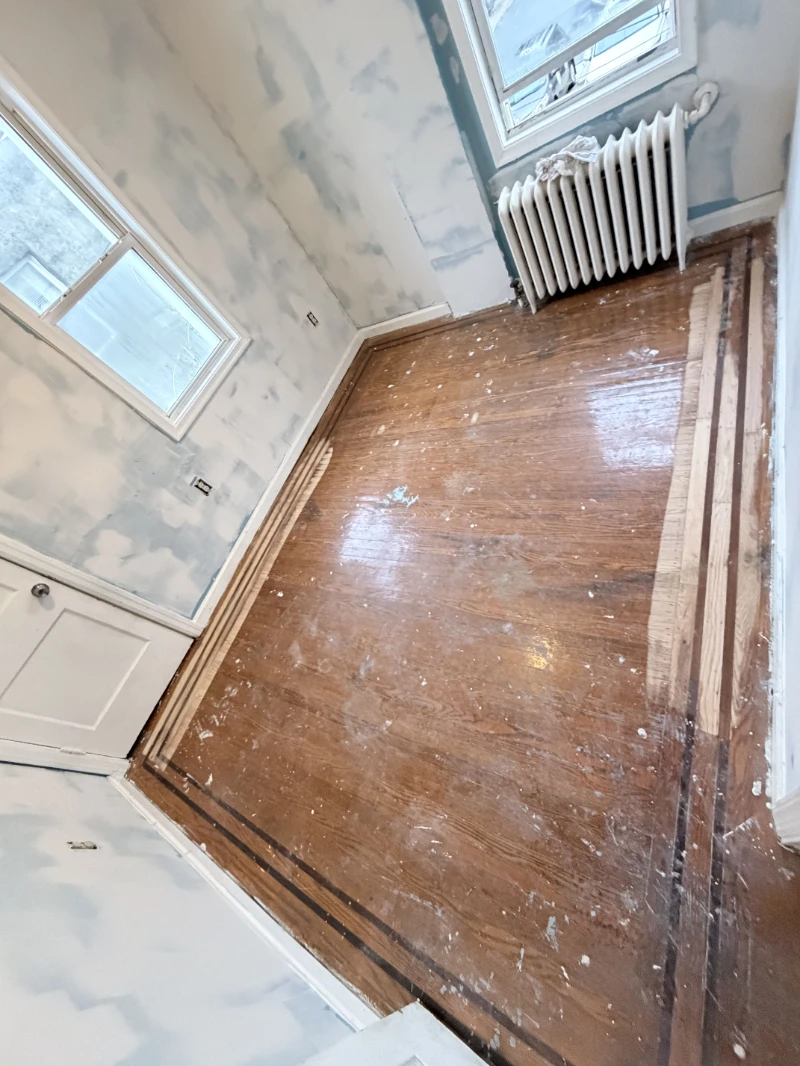
It is the right approach for localized damage, and its success is measured by whether the repair is invisible — which depends on matching species, grain, board width and finish to what is already there.
Key facts
| Typical causes | Water events, appliance leaks, pet damage, impact damage, failed prior repairs |
|---|---|
| Method | Board replacement woven into the existing floor |
| Match variables | Species, board width, grain orientation, thickness, finish |
| Common limitation | New wood does not carry the colour of aged wood |
Why repairs are visible, and what reduces it
New wood has not aged, and aged wood has changed colour — so a perfect board match is still a visible colour difference until the repair is blended.
Oak darkens and warms over decades of light exposure. A perfectly matched new board is the colour your floor was when it was installed, not the colour it is now.
This is why serious repairs are usually followed by refinishing at least the affected room, so everything reaches the same colour and sheen at the same time. A repair that is not refinished stays visible.
Weaving in beats cutting a patch
Replacement boards are staggered into the surrounding floor rather than removed as a rectangle, so there is no visible seam outlining the repair.
A square patch reads as a patch forever, no matter how well finished. Staggering the joints so they fall in the same random pattern as the rest of the floor is what makes a repair disappear.
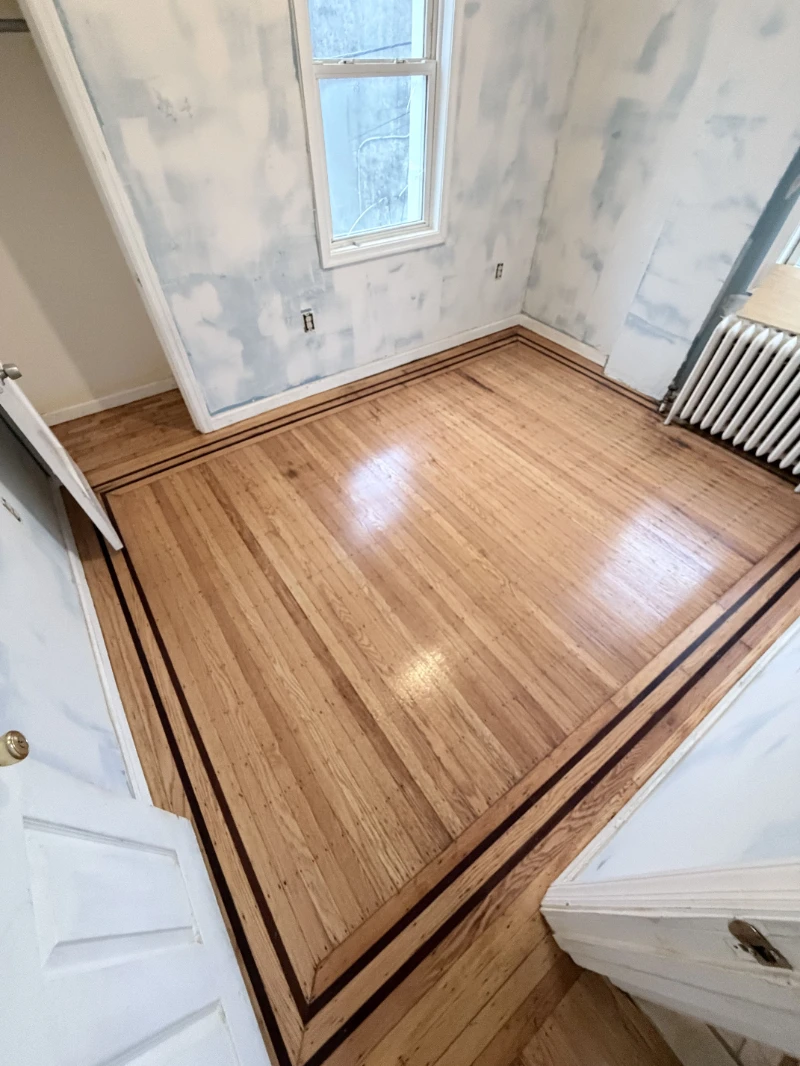
Repair versus refinish versus replace
Localized damage on a floor with wear layer left is a repair; widespread wear is a refinish; damage past what sanding can reach is replacement.
Most floors we are called to look at need a combination — replacement of a handful of boards, then a refinish of the room to bring everything together.
Where the honest answer is replacement, we say so. A refinish on a floor without wear layer left is money spent on a result that cannot be delivered.
Find the cause before fixing the symptom
Water-damaged boards will be damaged again if the leak, the crawlspace humidity or the failed seal that caused it is still there.
We look for the source before quoting the repair. Replacing boards under a still-leaking dishwasher is work that has to be done twice.
How VGJ Floors repairs a hardwood floor
Diagnose the cause
Identify what damaged the floor and confirm the source has been resolved before repair begins.
Match the material
Match species, board width, thickness and grain to the existing floor as closely as available material allows.
Remove damaged boards
Cut out affected boards cleanly without damaging the adjoining courses or the subfloor.
Weave in replacements
Stagger new boards into the surrounding pattern so no rectangular outline remains.
Sand the repair flush
Level the new material with the surrounding floor.
Blend the finish
Refinish the affected area or room so colour and sheen are continuous.
Frequently asked questions
Can you repair just a few boards?
Yes. The question is whether the repair will be visible afterward, which depends on how much the surrounding floor has aged and whether the area will be refinished.
Will the repair match my existing floor?
The material can be matched closely. Colour is the harder part, because new wood has not aged the way your floor has. Refinishing the room afterward is what makes a repair disappear.
How do you fix water-damaged boards?
First find and resolve the water source, then let the area dry fully. Only then are damaged boards replaced — otherwise the same damage returns.
Can squeaks be fixed without pulling up the floor?
Often. Squeaks usually come from movement between the flooring and the subfloor or from subfloor deflection, and many can be addressed from above or from below.
Is repair cheaper than refinishing?
For localized damage, usually. But a repair that is not blended stays visible, so the real comparison is repair plus refinishing the room against refinishing alone.
Get this quoted properly
We take moisture readings and check wear layer before putting a number on the job — so the quote matches what your floor can support.
Request a free estimate