
Hardwood Floor Refinishing
Refinishing sands a wood floor back to bare wood and rebuilds the finish on top of it.
- 5.0★★★★★85 Google reviews
- Since 2008
- 185 New Jersey towns
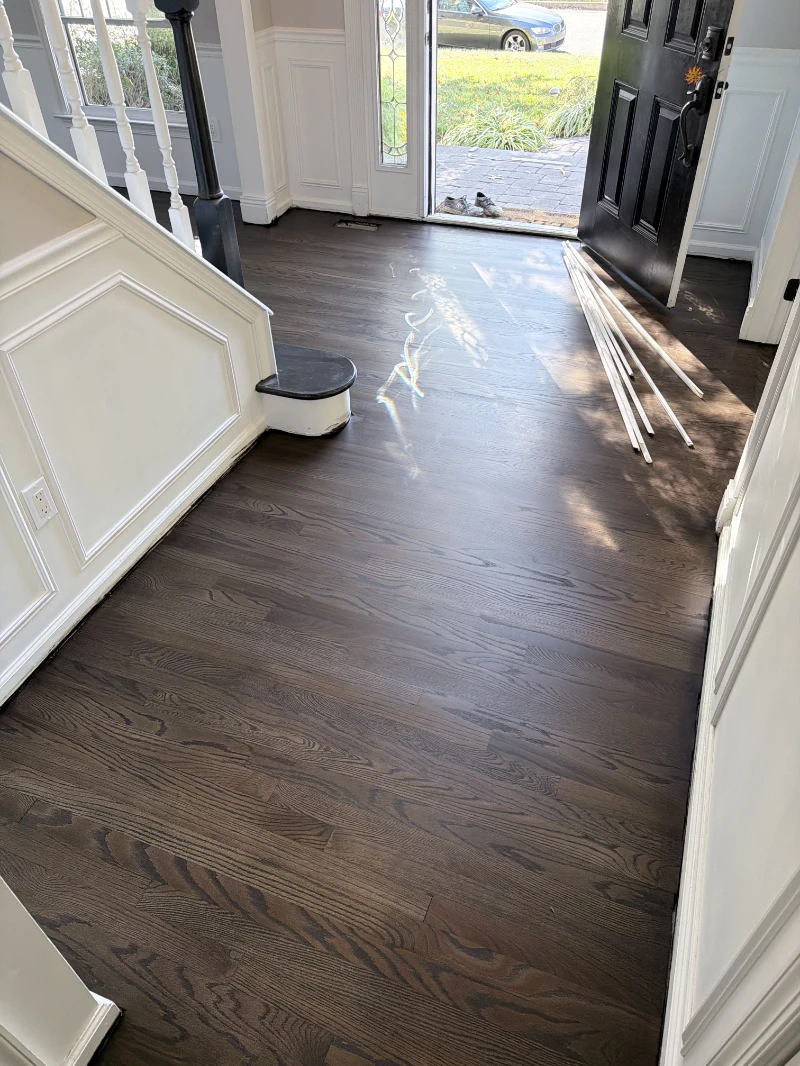
It removes scratches, gray areas and old stain colour, and it is the only process that resets a floor's appearance completely. It also consumes wear layer, which is why the first question on any refinishing job is how much wood is left.
Key facts
| What it removes | Scratches, gray traffic areas, old stain, cupping (after moisture is corrected) |
|---|---|
| What it cannot fix | Deep gouges through the wear layer, water-damaged boards, structural movement |
| Governed by | NWFA Wood Flooring Installation Guidelines |
| Pre-1978 homes | May trigger EPA RRP lead-safe requirements at baseboards and stairs |
| Typical service life of a refinish | Depends on traffic and finish system, not on the sanding |
How many times can a floor be refinished?
It depends on the wear layer — the thickness of usable wood above the tongue — not on the age of the floor.
A solid strip floor typically starts with enough material above the tongue for several full sandings across its life. How many remain depends on how many have already happened and how aggressively they were done.
This is measurable rather than a matter of opinion. Lifting a floor vent or a threshold usually exposes the edge of the board, and the distance from the surface down to the top of the tongue can be seen directly.
Engineered flooring is a different calculation entirely. What matters there is the thickness of the hardwood veneer over the plywood core, and thin-veneer engineered products may support only a light abrasion rather than a full sanding.
When refinishing is the wrong answer
If the wear layer is gone, if boards are cupped from an unresolved moisture source, or if damage runs deeper than the sanding depth, refinishing will not fix the floor.
Sanding a cupped floor flat is the most expensive version of this mistake. Once the moisture equalizes, the boards flatten and what was cupped becomes crowned — a worse problem, created by the repair.
The correct sequence is to find the moisture source, let the floor equalize, and only then sand. A contractor who wants to sand a cupped floor next week has not done the first step.
We will say when replacement or partial board replacement is the better answer. Talking a homeowner into a refinish that cannot deliver is how a floor gets two bills instead of one.
The grit sequence is the job
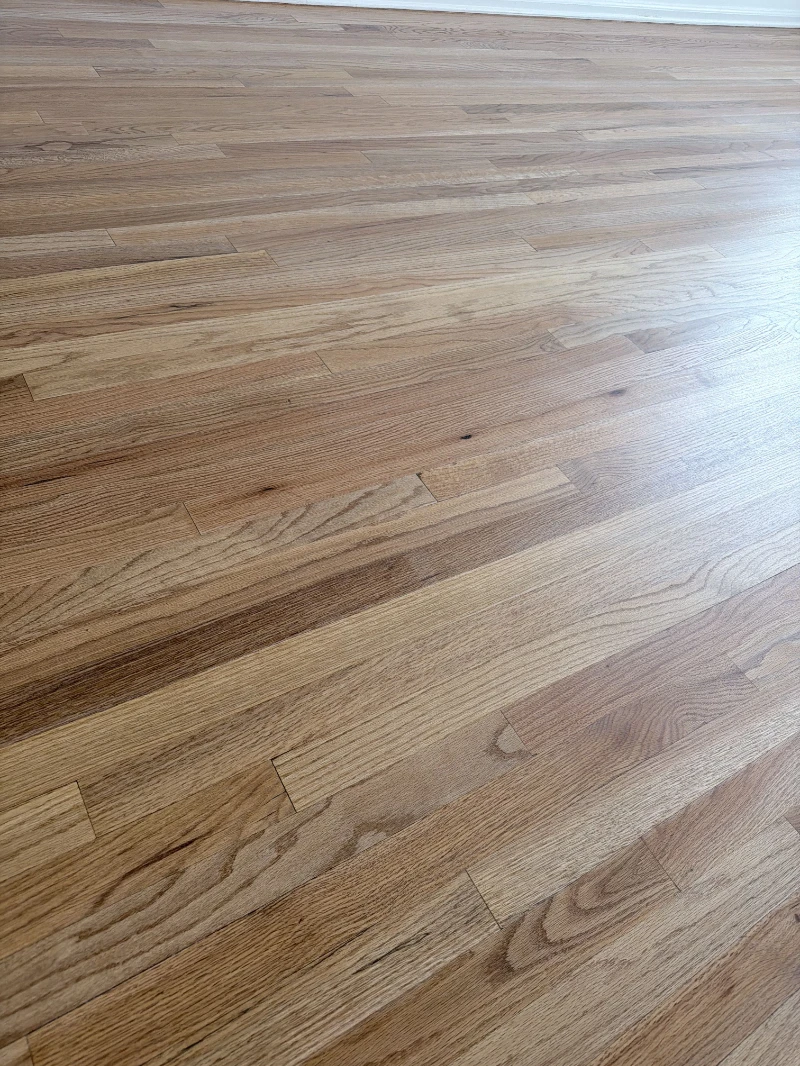
Sanding progresses through successively finer abrasives, and skipping a grit leaves scratches from the coarser one that only appear once the finish goes on.
A typical progression steps from a coarse cut that removes the old finish and levels the surface, through intermediate grits, to a final pass fine enough that the surface takes finish evenly.
This is where the difference between crews shows up, and it is invisible until it is too late. Finish is transparent: it does not hide scratch pattern, it magnifies it under raking light.
Edges, corners and stairs are separate work
The large machine reaches the field of the floor; perimeters, closets, corners and stairs are cut with different equipment and take a disproportionate share of the labour.
A quote that treats a room as a simple square-foot number is quoting the field and ignoring the perimeter. Rooms with many closets, radiators, or built-ins carry more edge work per square foot than an open floor of the same size.
Pre-1978 houses change the job
In housing built before 1978, sanding that disturbs painted baseboards, shoe molding or stair components may fall under the EPA's lead-safe rule.
Across the New Jersey towns we serve, roughly 65% of housing predates 1978, so this is the common case rather than the exception.
Dust containment and lead-safe practice are not the same thing. A containment system manages nuisance dust; the RRP rule addresses a regulated hazard and has its own containment, cleaning and verification requirements.
How VGJ Floors refinishes a wood floor
Assess wear layer and moisture
Measure remaining wood above the tongue and take moisture readings before quoting, so the plan matches what the floor can actually support.
Protect and contain
Seal off adjacent rooms, cover vents and set up dust containment before any machine runs.
Cut and level
Remove old finish and level the surface with the coarse pass, then work through the grit sequence.
Edge, corner and detail
Cut perimeters, closets and corners with edger and hand tools to match the field.
Screen and inspect
Final abrasion, then inspect under raking light for scratch pattern before any finish is applied.
Stain and finish
Apply stain if specified, then build the finish coats according to the manufacturer's schedule.
Cure and hand back
Walk the floor with the homeowner and provide the cure schedule for furniture and rugs.
Frequently asked questions
How do I know if my floor can be refinished again?
Look at an exposed board edge, usually at a floor vent or a threshold. What matters is the wood remaining above the tongue. If it is thin, or if the floor is engineered with a thin veneer, a full sanding may not be possible.
How long does refinishing take?
The sanding is usually the fast part. The schedule is driven by the finish system: how many coats it needs, how long between coats, and how long before furniture and rugs can return.
Can I stay in the house during refinishing?
It depends on the finish and the layout. Waterborne finishes have much lower odor than solvent-based ones, but the work area still has to stay clear while coats cure.
What decides the cost of a refinishing job?
Square footage is only the starting point. Edge work, stairs, closets, the number of coats, whether stain is involved, board condition, and lead-safe requirements in pre-1978 homes all move the number.
Will refinishing remove pet stains?
Sometimes. Surface discoloration sands out. Urine that penetrated past the finish into the wood — often showing as a dark or black stain — usually does not, and those boards need replacement.
Do I have to remove all my furniture?
Yes, the work area has to be empty. Sanding equipment needs uninterrupted access to the field of the floor and to the perimeter.
Can you match the color of my existing floor?
Stain colour can be matched closely, but wood species and age affect how a stain takes. We test on your actual floor rather than relying on a sample board.
Get this quoted properly
We take moisture readings and check wear layer before putting a number on the job — so the quote matches what your floor can support.
Request a free estimate