
Screen and Recoat
A screen and recoat abrades only the existing finish and adds a fresh coat on top.
- 5.0★★★★★85 Google reviews
- Since 2008
- 185 New Jersey towns
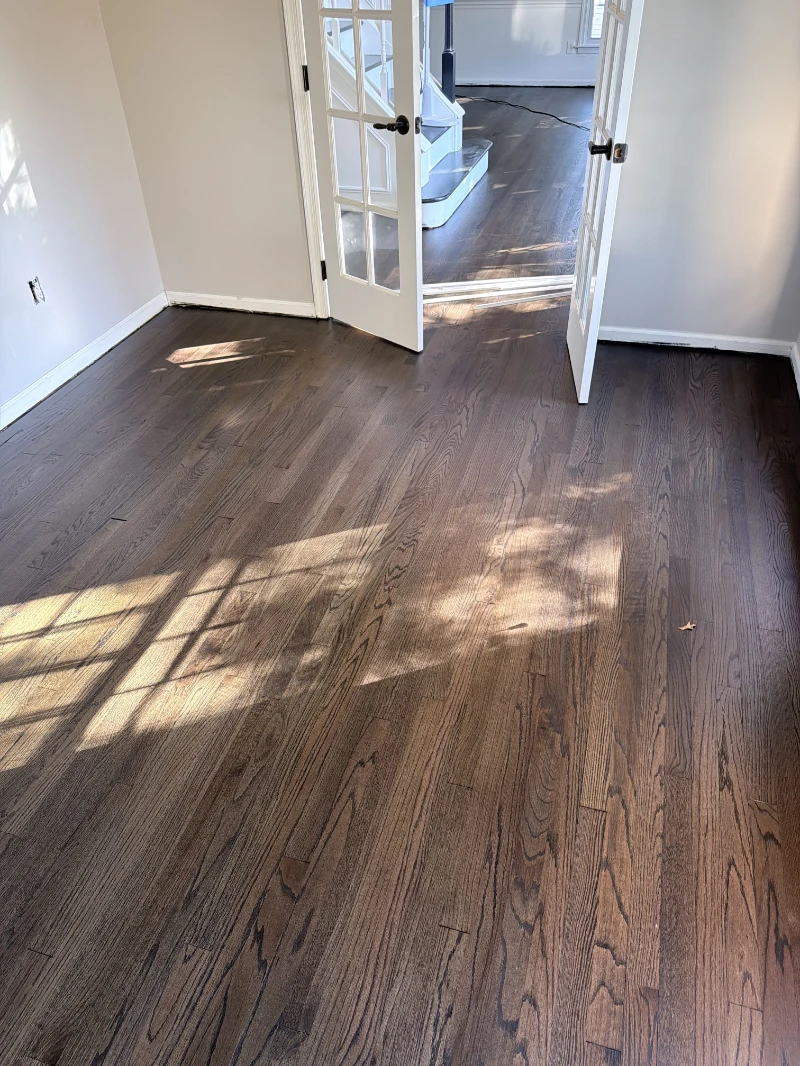
It restores sheen and protection without sanding into the wood, so it consumes no wear layer. It is the right answer for a floor that is dull and lightly scuffed, and the wrong answer for a floor with stains or worn-through areas.
Key facts
| Also called | Buff and coat, recoat |
|---|---|
| Removes | Nothing from the wood — abrades the finish only |
| Wear layer consumed | None |
| Fixes | Dull sheen, light surface scuffing |
| Does not fix | Stains, gray worn-through areas, deep scratches, colour change |
How to tell whether your floor is a candidate
If the wear is in the finish, a recoat works. If the wear has reached the wood, it does not.
Gray or dull patches in traffic lanes usually mean the finish has worn through and the bare wood beneath is oxidizing. A new coat over that will seal in the gray rather than remove it.
A simple check: a drop of water left on a worn area for a few minutes will darken bare wood, while an intact finish will bead it. If the wood darkens, the finish is gone in that spot.
Why it is worth doing before you need a refinish
Recoating on schedule protects the wear layer, which is the finite resource in any solid wood floor.
Every full refinish costs wood that cannot be replaced. A floor maintained with periodic recoats stays in service far longer than one run to failure and then sanded.
This is the least profitable service we offer per visit and the one that saves homeowners the most money over the life of a floor.
Where recoating fails
Adhesion. A new coat has to bond to the old finish, and contamination on the surface will prevent it.
Residue from acrylic waxes and some polish products is the usual culprit. It is invisible, and it causes the new coat to peel weeks later.
This is why a test area is worth doing before committing the whole floor, and why we ask what has been used to clean the floor over the years.
How VGJ Floors performs a screen and recoat
Assess finish condition
Check for worn-through areas, stains and any sign of contamination that would block adhesion.
Test adhesion
Abrade and coat a small area, then verify the bond before proceeding across the floor.
Clean thoroughly
Remove residue so the new coat bonds to finish rather than to contamination.
Abrade the finish
Screen the surface to give the new coat mechanical bite, without cutting into the wood.
Apply the coat
Apply finish per the manufacturer's schedule and cure time.
Frequently asked questions
What is the difference between a recoat and a refinish?
A recoat abrades and re-coats the existing finish, consuming no wood. A refinish sands back to bare wood, which resets appearance completely but uses up wear layer.
How often should a floor be recoated?
It depends entirely on traffic. The signal is dulling sheen, and the goal is to recoat while wear is still in the finish rather than in the wood.
Will a recoat remove scratches?
Light surface scuffing in the finish, yes. Scratches that reach the wood will still be visible, because the coat is transparent.
Can a recoat change my floor's colour?
No. Colour change requires sanding to bare wood and applying stain.
Why would a recoat peel?
Almost always adhesion failure from residue on the old finish, commonly from acrylic waxes or polish products. That is why a test area comes first.
Get this quoted properly
We take moisture readings and check wear layer before putting a number on the job — so the quote matches what your floor can support.
Request a free estimate