
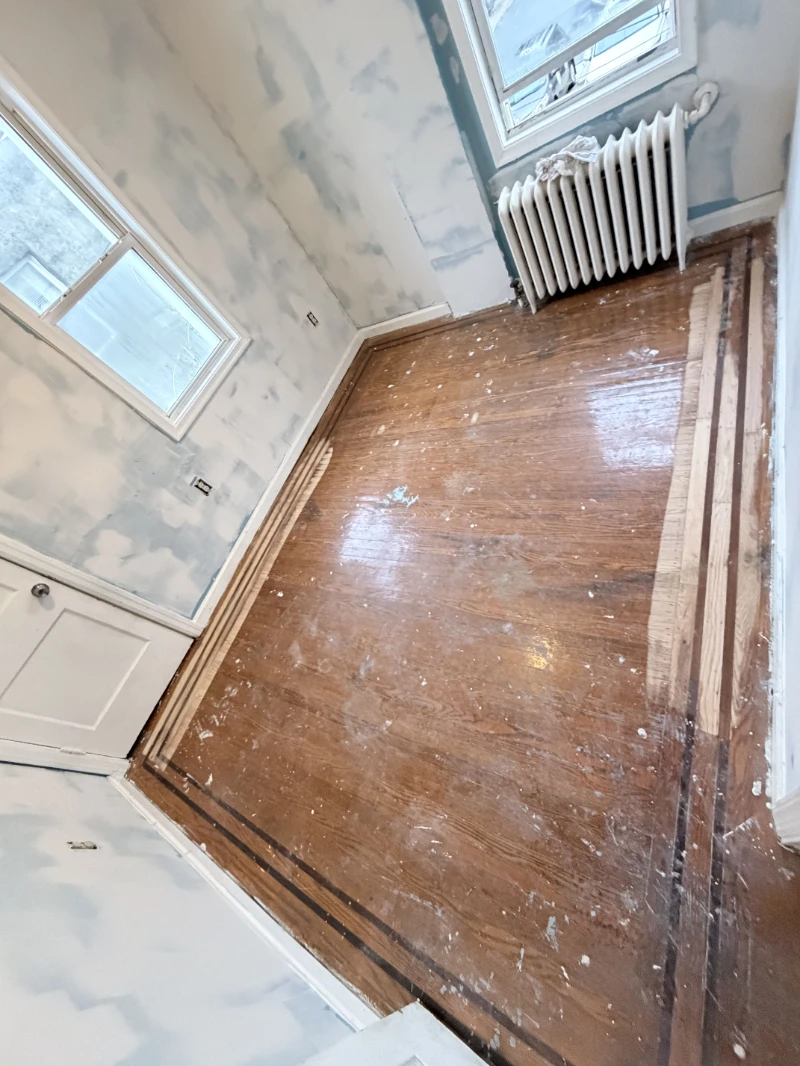
Refinishing & Sanding
When You Should Not Refinish Your Floors
Most articles about refinishing are written to sell refinishing.
Refinishing sands a wood floor back to bare wood and rebuilds the finish on top.
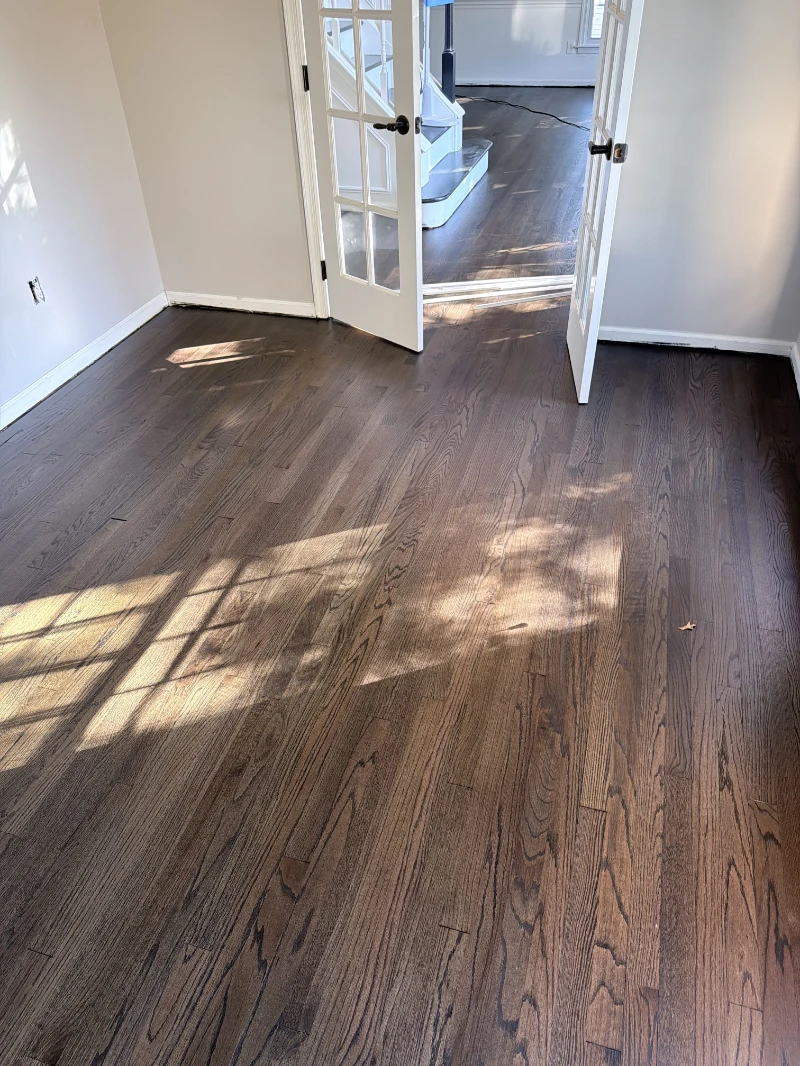
In New Jersey, whether that is the right move depends on two things above all: how much wear layer your floor has left, and how old your house is. Roughly 65% of homes in the towns we serve predate 1978, which brings federal lead-safe rules into the job before any question of colour comes up.
Look at an exposed board edge — usually visible at a floor vent or a threshold — and judge the wood remaining above the tongue, not the age of the floor.
Solid strip flooring starts with enough material above the tongue for several sandings across its life. How many are left depends on how many have already happened and how aggressive they were.
Engineered flooring is a different calculation entirely: what matters is the thickness of the hardwood veneer over the plywood core. Thin-veneer products may tolerate only a light abrasion, or nothing at all, and the difference is not visible from above.
This is the first thing we measure and the reason we do not quote a per-square-foot rate over the phone.
Sanding a cupped floor flat before the moisture has equalised turns a temporary problem into a permanent one.
Cupping means the underside of the boards holds more moisture than the top. As the assembly dries, the boards flatten on their own — often far more than anyone expects.
Sand while they are still cupped and you remove material from the raised edges. When the board later flattens, the centre stands proud. That is crowning, and the only way out is more sanding on a floor that has already lost wear layer.
The correct sequence is: find the moisture source, fix it, let the floor equalise, verify with readings, then sand. Waiting is the intervention.
NWFA guidance calls for no more than 4% moisture difference between subfloor and solid strip flooring, at least 20 readings per 1,000 square feet, and jobsite conditions of 60–80 °F and 30–50% relative humidity held for five days.
These are not house rules. They are the industry guidelines a manufacturer's warranty will point to if a floor fails, which is why documented readings matter more than a contractor's assurance that everything looked fine.
Ask for the readings in writing: the meter used, where readings were taken, the subfloor value, the flooring value, and the room conditions on the day. It costs a contractor nothing if the work was done.
In housing built before 1978, sanding that disturbs painted baseboards, shoe molding or stair components falls under the EPA's Renovation, Repair and Painting rule.
The field of a floor is bare wood. The exposure is at the edges, and that is exactly where sanding equipment runs.
Across the New Jersey towns we serve the median pre-1978 share is about 65%, and 107 of 185 towns are above 60%. This is the normal condition of a job here, not an exception.
Dust containment is a separate matter. A vacuum system manages nuisance dust; the RRP rule addresses a regulated hazard with its own containment, cleaning and verification requirements. Ask about both.
If wear is still in the finish, recoat. If it has reached the wood across the floor, refinish. If damage is localised and wear layer remains, repair and then refinish the room.
A simple test: leave a drop of water on a dull traffic area for a few minutes. If it beads, the finish is intact and a screen and recoat will restore it without touching the wood. If the wood darkens, the finish is gone there and a recoat would seal in the grey rather than remove it.
Recoating on schedule is the single cheapest thing a homeowner can do for a wood floor, because it protects the finite resource — the wear layer.
The decision is colour, odour and schedule, in that order — durability differences within quality products are smaller than the marketing suggests.
Oil-modified polyurethane ambers the wood and keeps ambering with age. Waterborne holds the colour as it looked on day one. Neither is reversible without sanding, so decide deliberately rather than inheriting whatever is on the truck.
Penetrating hardwax oils bond into the top fibres instead of forming a film, which allows invisible spot repair at the cost of the abrasion resistance a catalysed film gives. It is a real trade-off, not a ranking.
Square footage is the starting point; edge work, stairs, closets, coat count, stain and lead-safe requirements are what actually move the number.
The open field of a floor is fast — a machine covers it. Perimeters, closets, corners and stairs are cut with different equipment and finished by hand, and a room full of radiators and built-ins carries far more hand work per square foot than an open room of the same size.
We do not publish a per-square-foot rate, because a rate applied without seeing the floor is a guess dressed as a quote.
Assess and measure, contain the area, cut and level, work through the grit sequence, detail the edges, screen and inspect, then stain and finish on a schedule set by the product.
The assessment is not a formality. Wear layer at an exposed edge, moisture readings across the field and the perimeter, fastener depth, board condition and any cupping all get recorded before a machine comes off the truck.
Containment goes up next: adjacent rooms sealed, HVAC supply and return vents covered. In an occupied house this is the difference between living there during the work and not.
The coarse pass removes the old finish and levels the field. Every pass after it exists to erase the scratch pattern the previous one left, which is why the sequence cannot be shortened.
Edges, closets and corners are cut with an edger and by hand, then blended into the field. A visible line where that work meets the field is the most common defect in a finished floor, and it is a matter of care rather than equipment.
Before any finish goes down the whole floor is screened and inspected under raking light. Finish is transparent, so it magnifies scratch pattern rather than hiding it.
Look for four things: the moisture readings, the grit sequence, the named finish product with its coat count, and how stairs and edge work are priced.
A quote that gives only a square-foot rate and a total is describing the field of the floor and ignoring everything that actually varies. Ask what the readings were.
Three coats of polyurethane is not a specification. Which product, waterborne or oil-modified, one component or two? Each has a published data sheet, and the difference between them is the difference in how the floor performs and how it looks in ten years.
Stairs should be priced separately and per tread. A staircase folded into a square-foot number is either being underpriced now or renegotiated later.
Keep grit off it, control humidity through the seasons, and recoat before wear reaches the wood.
Most damage to a finished floor is abrasive: grit tracked in from outside acts as sandpaper underfoot. Mats at entries do more for a floor's life than any product applied to it.
Solid wood moves with seasonal humidity. Fine gaps in February that close by August are normal behaviour, not a defect.
Avoid acrylic waxes and polish products. They build a residue that is invisible until it prevents a future recoat from bonding, and then the fix is a full sanding rather than a recoat.
It depends on the wear layer remaining above the tongue, not on a fixed number. Solid strip flooring generally supports several sandings across its life; engineered flooring is limited by veneer thickness and may support only one, or none.
Sanding is usually the fast part. The schedule is set by the finish system — how many coats, how long between them, and how long before furniture and rugs can return.
Often yes with a waterborne finish, which has far lower odour than solvent-based products. The work area still has to be clear while coats cure.
Surface discoloration sands out. Dark or black staining is a reaction deep in the wood, usually deeper than the remaining wear layer, and those boards need replacement.
No. It captures the large majority of dust at the machine, which makes a real difference in an occupied house, but no system eliminates dust entirely.
NWFA guidance that the moisture content difference between the subfloor and solid strip flooring should not exceed 4% before installation. A larger gap guarantees movement after the floor is down.
Send photos and the town you are in. We will tell you which of this actually applies to your house.
Request a free estimateRefinishing & Sanding
Most articles about refinishing are written to sell refinishing.
Refinishing & Sanding
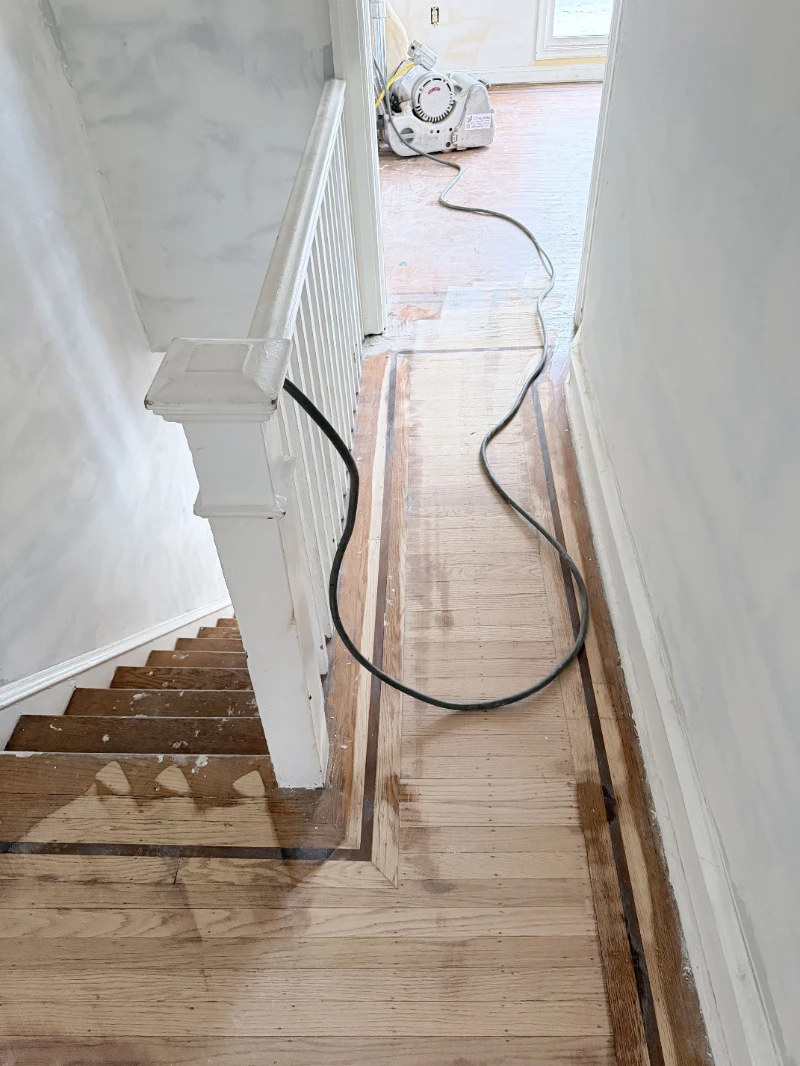
Dustless sanding runs the equipment through a vacuum and containment system, usually HEPA-filtered, so most dust is captured…
Refinishing & Sanding
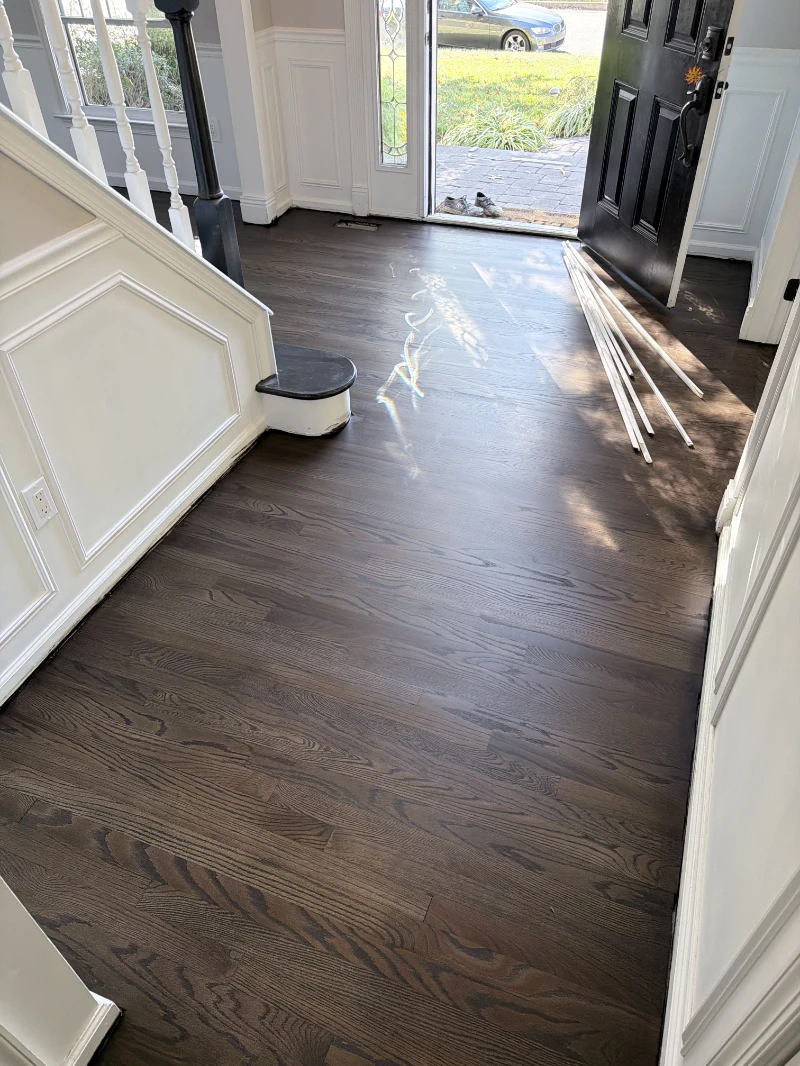
The choice between oil-modified and waterborne polyurethane comes down to three things: colour, odour and schedule.